
Pakistan Floods 2025: 500000 Evacuated in Punjab
Introduction
In August 2025, Pakistan’s Punjab province experienced one of the worst flood disasters in its history. After days of relentless monsoon rains, three major rivers — Chenab, Ravi, and Sutlej — overflowed at the same time, something that has never happened before. The result was catastrophic: hundreds of villages went underwater, farmlands disappeared, and nearly half a million people were forced to leave their homes.
This event is not just another natural disaster — it is a humanitarian crisis that reflects the growing challenges of climate change, poor planning, and fragile infrastructure in South Asia.
The Scale of the Disaster
Key Numbers That Show the Crisis
- Evacuated people: Around 481,000 people have been rescued from flooded areas.
- Total affected population: More than 1.5 million people across Punjab.
- Deaths recorded: 835 nationwide since the monsoon season began in late June.
- Livestock rescued: Over 405,000 animals evacuated to safer ground.
- Villages submerged: More than 2,300 rural settlements underwater.
- Rescue teams deployed: 1,300 personnel with the support of over 800 boats.
Why This Flood is Unique
- It marks the first time in Pakistan’s history that all three major rivers in Punjab overflowed together.
- The government carried out controlled breaches of embankments (protective barriers) to divert water away from cities, but this left many villages completely flooded.
- The timing was especially harsh for farmers, as crops and livestock were destroyed just before harvest season.
The Human Side of the Tragedy
For many families in Punjab, the floods have taken everything. Homes built over generations were washed away in hours. Farmers lost not only their standing crops but also the animals they depended on for milk and livelihood.
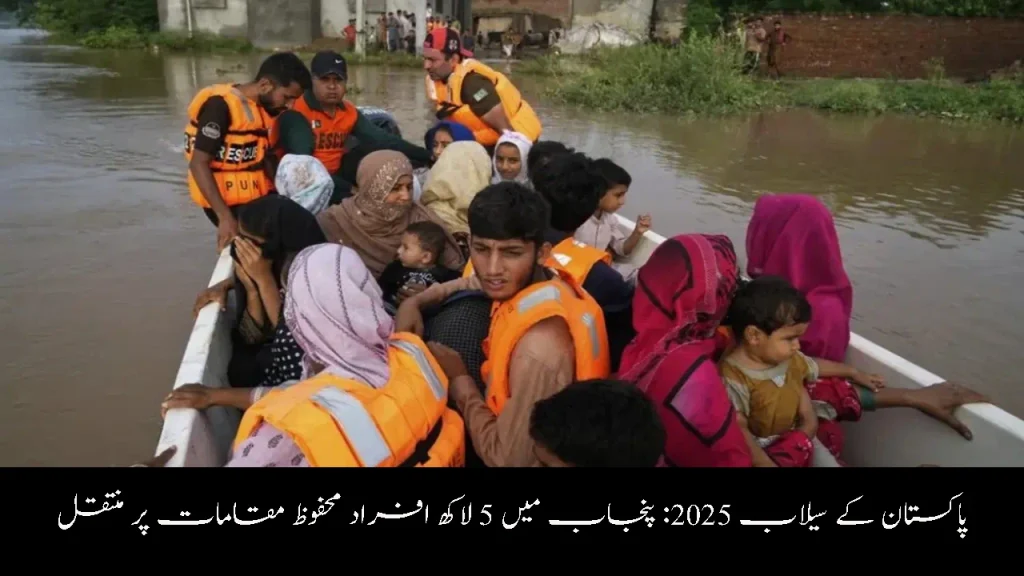
Mothers carried children on their shoulders through waist-deep water. Elderly villagers had to be rescued by boats. For those living in temporary camps, life now revolves around scarcity of clean water, food, and medicines.
Health experts are warning about the rapid spread of waterborne diseases like cholera, diarrhea, and hepatitis. With hospitals already under strain, the medical system is struggling to keep up.
How the Rescue Operation is Unfolding
This is being called the largest rescue operation in Punjab’s history.
- Boats and rescue units have been deployed to rural areas where roads are cut off.
- Temporary shelters have been set up in schools and government buildings.
- The Punjab Disaster Management Authority (PDMA) has been coordinating evacuations, with help from local volunteers and security forces.
- Special arrangements were made for the rescue of livestock, as animals are a key part of rural survival.
Officials have acknowledged that despite massive efforts, many communities are still waiting for help due to the sheer scale of the floods.
The Bigger Picture: Climate and Environment
Pakistan has faced repeated flooding in recent years. Experts point to several reasons:
- Climate Change: Rising global temperatures are causing heavier monsoon rains and unpredictable weather.
- Melting Glaciers: Pakistan has more glaciers than almost any other country outside the polar regions. Melting ice adds to river water levels during monsoons.
- Deforestation: Loss of forests has reduced natural barriers that once slowed down floodwaters.
- Urban Expansion: Construction on riverbanks has made floods more destructive than before.
This combination means Pakistan’s flood problem is no longer a once-in-a-decade event. It is becoming a regular and deadly pattern.
FAQs About the Floods
How many people have been evacuated?
Nearly half a million people have been rescued, but over 1.5 million remain affected.
Why are these floods being called historic?
Because all three rivers in Punjab flooded simultaneously for the first time in history.
Which areas are worst affected?
Villages located along the Chenab, Ravi, and Sutlej rivers, especially in low-lying rural districts.
What is being done for the victims?
The government and PDMA are providing shelters, food, and medical support, but relief is struggling to match the needs.
Is climate change making things worse?
Yes. Changing rainfall patterns, glacier melting, and deforestation are all increasing the frequency and intensity of floods in Pakistan.
Conclusion
The Punjab floods of 2025 are a devastating reminder of how vulnerable communities are in the face of nature’s fury. While rescue efforts are ongoing and thousands of lives have been saved, the long-term damage will be felt for years to come. Families have lost their homes, farmers have lost their livelihoods, and entire villages have been erased from the map.
Beyond the immediate rescue, Pakistan must focus on climate resilience, better planning, and environmental protection. Without stronger systems in place, such disasters will only grow in frequency and intensity, leaving millions more at risk.
The people of Punjab are resilient, but resilience alone cannot fight climate change. It requires global cooperation, smarter policies, and urgent action to prevent future tragedies.
Read this: Heavy Rainfall in Lahore 2025: Urban Flooding Traffic & School Closures
Read this: Assistant Commissioner Pattoki Furqan Muhammad Khan Dies During Flood Relief Efforts